Online visibility leads to client inquiries when the right people can quickly understand four things:
- What you help with
- Who your work is for
- Why they should trust your point of view
- What they should do next
Posting more content does not automatically create more inquiries. Your content needs to connect your expertise to a problem someone is ready to solve.
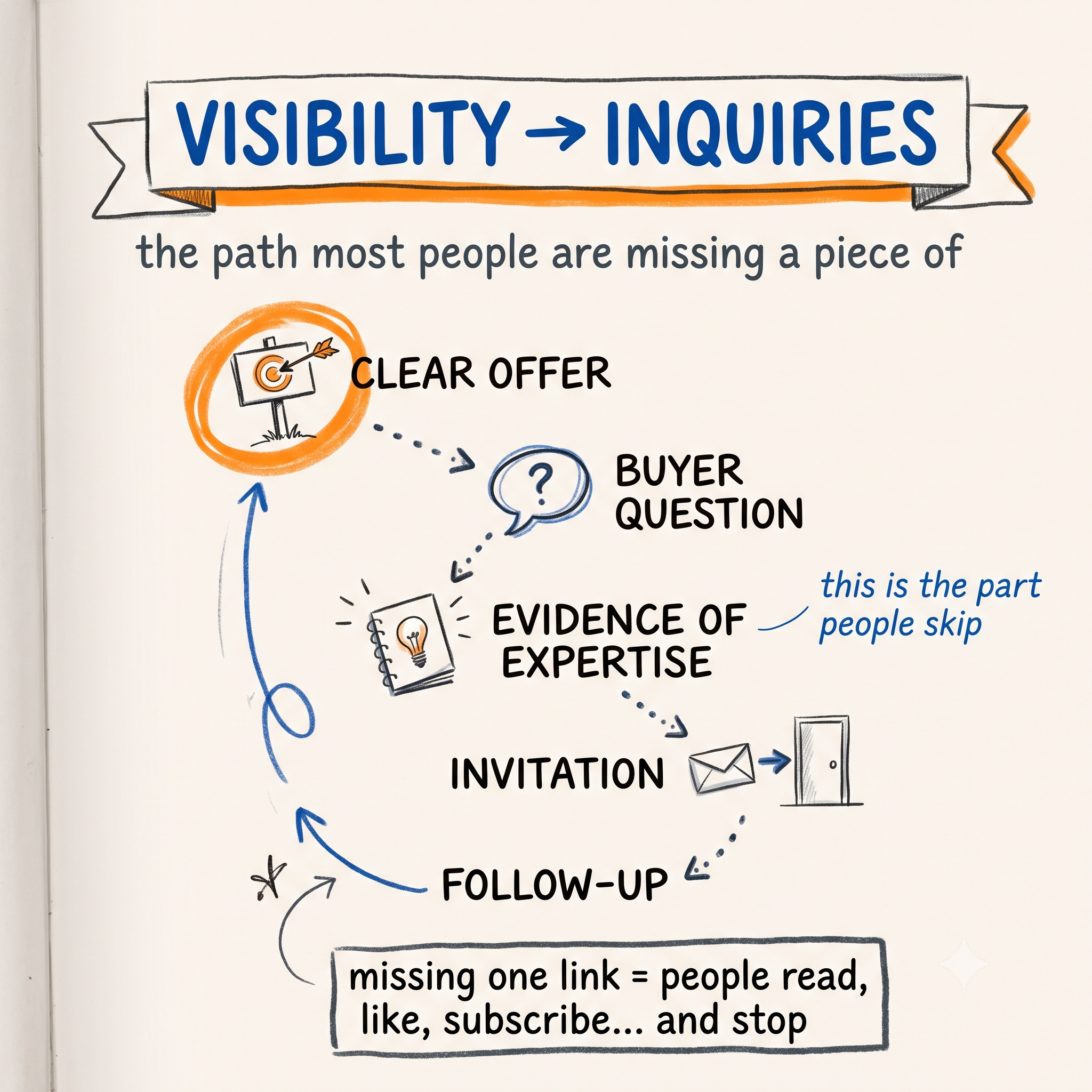
A useful visibility path looks like this:
Clear offer → buyer question → evidence of expertise → invitation → follow-up
When one part is missing, people may read, like, or subscribe without taking the next step.
Start With a Clear Offer
Before creating more content, decide what you want the content to lead to.
This could be:
- A consultation
- A coaching package
- A workshop
- A course
- A newsletter subscription
- A specific service
The offer gives your visibility work a destination.
For example, my Clarity & Action: Your 30-Day Marketing Plan is for experienced solo business owners whose marketing feels scattered. The service helps them choose their priorities, create a realistic 30-day plan, and follow through with support.
That clarity helps me decide which questions to answer in my content.
I might write about:
- How to choose a marketing priority
- What to do when your marketing feels scattered
- How to create a 30-day visibility plan
- How to decide which marketing tasks to ignore
- Why a plan often breaks down during implementation
Each topic connects to a problem the service helps solve.
Without a clear offer, content often becomes a collection of useful tips with no obvious business direction.
Answer Questions Potential Clients Ask Before Hiring
Your best content topics often come from the questions people ask while deciding whether they need help.
These are different from broad educational questions.
A broad question might be:
How do I become more visible online?
A buyer-focused question is more specific:
How do I know which visibility activities are worth my time?
Other buyer questions could include:
- Do I need a marketing plan or more consistent content?
- Which platform should I focus on?
- Why am I getting engagement but few inquiries?
- How much time should I spend on visibility each week?
- When should I get outside marketing help?
These questions matter because they appear closer to a decision.
They help potential clients understand their problem, compare possible solutions, and decide what kind of support would help.
Show Evidence of Your Expertise
Answering the question is only part of the job. Your content also needs to show how you think.
Experienced consultants, coaches, and service providers often have years of knowledge that never becomes visible in their content. They publish short tips, quotes, reminders, and general advice, while the most valuable part of their expertise stays hidden.
To make your experience easier to recognize, include:
- The reasoning behind your recommendation
- Signs that help someone assess their situation
- Examples from your work
- Common patterns you have noticed
- Conditions or exceptions
- The steps in your process
- The consequences of different choices
For example, instead of saying:
Be consistent with your marketing.
You could explain:
Choose a publishing schedule you can maintain for at least three months. A weekly newsletter may be more useful than daily social posts when your goal is to develop trust and stay in contact with potential clients.
The second version gives the reader something they can assess and apply. It also shows the thinking behind the recommendation.
This type of detail helps readers decide whether your approach fits them. It also gives search engines and AI tools clearer information about your subject and point of view.
Give the Reader a Relevant Next Step
Every piece of content should lead somewhere useful.
That does not mean every article needs an aggressive sales pitch. The next step should match the reader’s likely level of readiness.
A reader who has just discovered you may be ready to:
- Read a related article
- Download a checklist
- Subscribe to your newsletter
- Review an example
- Complete a short assessment
A reader who already understands the problem may be ready to:
- View a service page
- Attend a workshop
- Reply to an email
- Ask a question
- Book a consultation
Weak next steps
These CTAs are common, but they give the reader little direction:
- Learn more
- Contact me
- Follow for more tips
- Let me know what you think
- Check out my services
The reader has to decide why the next step matters.
Stronger next steps
A stronger invitation connects directly to the problem discussed:
- Marketing feels scattered? See how we can create a focused 30-day plan you can carry out.
- Want a simpler way to connect your LinkedIn posts and newsletter? See how The Visibility Loop works.
- Not sure where your visibility path breaks down? Complete the Visibility Momentum Map assessment.
- Want practical guidance on visibility and AI? Subscribe to Your Visibility Edge.
The reader can see what comes next and why it may help.
Follow Up After Someone Shows Interest
Most people will not hire you after seeing one post.
They may need to read several articles, receive a few emails, attend an event, or observe your work over time.
Follow-up keeps the relationship moving.
A simple follow-up system could include:
- A person discovers an article or social post.
- The content invites them to subscribe or download a related resource.
- The welcome email introduces your main ideas and points them to a useful article.
- Later emails answer more buyer questions.
- Relevant emails invite them to review a service or attend a workshop.
- You continue the conversation when they reply, attend, click, or ask a question.
The goal is to make it easy for someone to move from awareness to interest, and from interest to conversation.
My Visibility Loop teaches a connected approach using LinkedIn and a newsletter. One useful idea becomes several pieces of content, and each piece supports the next instead of standing alone.
Where Does the Visibility Path Break?
When visibility is not leading to inquiries, review each stage.
1. Is the offer clear?
Can someone tell what you help with, who it is for, and what changes after working with you?
If the offer is vague, your content will also be difficult to focus.
2. Are you answering meaningful buyer questions?
Does your content address questions people ask while considering help?
General inspiration may get attention without helping someone make a decision.
3. Does the content show your experience?
Are you explaining your reasoning, process, examples, and recommendations?
A list of familiar tips may not give the reader enough reason to remember you.
4. Is there a relevant invitation?
Can the reader tell what to do next and what they will gain from doing it?
A buried link or vague “contact me” message creates unnecessary work for the reader.
5. Is there a follow-up path?
What happens after someone subscribes, downloads, attends, or replies?
Without follow-up, signs of interest are easy to miss.
A Simple Content-to-Inquiry Check
Before publishing anything, ask these five questions:
- Which offer or business goal does this content support?
- What specific client question does it answer?
- What experience, reasoning, or example am I adding?
- What is the most useful next step for the reader?
- What happens after the reader takes that step?
If you cannot answer one of these questions, you may have found the weak point in the content.
For example:
| Content element | Example |
|---|---|
| Offer | Clarity & Action: Your 30-Day Marketing Plan |
| Buyer question | How do I decide what to focus on in my marketing? |
| Evidence | A decision process, client pattern, or example |
| Invitation | Review the 30-day planning service |
| Follow-up | Purchase, inquiry, email conversation, or related article |
This does not mean every post must sell one offer directly. It means your content should have a purpose and a place in the larger path.
How Long Does It Take for Visibility to Produce Inquiries?
There is no standard timeline.
Results depend on:
- How clear your offer is
- How well your content matches buyer questions
- Whether the right people see it
- How often you publish and follow up
- The strength of your existing reputation
- The price and complexity of the service
Someone may inquire after reading one detailed article because they already know they need help. Another person may subscribe for several months before reaching out.
The better question is:
Does my visibility system give an interested person a clear way to keep moving toward a conversation?
You cannot control when someone is ready. You can make the path easier to follow.
What Should I Do First?
Choose one paid offer and write down five questions a potential client might ask before buying it.
Then choose one question and create a complete answer that includes:
- A direct response
- Your reasoning
- A practical example
- A related next step
- A plan for follow-up
One useful answer connected to a clear offer can do more business work than several unrelated posts.
If your marketing feels scattered and you need help deciding what to focus on, Clarity & Action: Your 30-Day Marketing Plan gives you a focused plan and support carrying it out.


What a clear and helpful post, Denise. It makes complete sense, and these steps are right even as technology, platforms, and tools change all the time.
Thanks, Elizabeth! Change is the only constant and we need to keep up best we can.